Unit five, section one#
Introduction to high level programming
Challenge work submission#
Read chapter 13 of the textbook.
Complete challenge work #3, on page 649 of the text.
Note
Corresponds to challenge work #3, on page 649 of the text. The instructions may say a short profile, but the course Brightspace says 2-3 paragraphs is sufficient.
Simscript#
When you want to model simulations, simscript is a better choice than a general purpose language (GPL), especially if you’d like to work with the modelling quickly and forego a lot of the programmatical noise.
The key features that stand out in the simscript documentation are built-in constructs for simulation modelling, which may need to be coded as structs manually if using C++. The code is different from a GPL language, and is reminiscent of the english language, making it incredibly accessible and abstracted at a high level. Both the built-in struct utility and the natural language allows simscript to be used for faster modelling of complex simulations. GPLs in contrast, would be verbose and clunky to code the equivalent.
The main difference between simscript and other GPLs is it’s drawback: simscript doesn’t handle general programming tasks, and has a narrow scope of focus in its implementation since it’s purpose built for simulation. As a less used language, it also has limited resources available. Aside a few technical manuals and documentation references, there are limited forums, videos, and open source documentation portals for extending implementation or projects.
Works cited#
Schneider, G. Michael, and Judith Gersting. Invitation to Computer Science. 6th ed., Cengage Learning, 2013.
Markowitz, H. M., Hausner, A., & Karr, H. (1987). Building simulation models with SIMSCRIPT II.5. CACI Products Company. Retrieved from https://www3.cs.stonybrook.edu/~cse529/simscript_docs/simbuild.pdf
Assignment 5 (chapter thirteen, section five)#
10. Assume that you want to model a bus system in which passengers purchase tickets and travel from city A to one of four other cities, either B, C, D, or E. An important part of the model is determining to which city a specific passenger is traveling, a random variable. How might you go about creating a statistical distribution that accurately specifies to which of these four cities a passenger will buy a ticket and travel? (Chapter 13, page 650.)
To do this, I would create a probability distribution and evaluate historical ticket patterns in sales, which would help me determine the proportion of passengers that travel to different nodes. Otherwise, an estimate might be generated based on factors like population size, activity (leisure or business route likelihood), and demographic (age, factoring likelihood of age versus type of travel). I can establish probabilities based on discrete distribution, once I have this categorical data.
Psuedocode#
I’m using a theoretical example that destination B is a main node, and passengers are 60% likely to arrive here regardless of leisure or business because it’s cheaper to go to the city and travel from B to C, D, or E. Leisure direct to C is 20% likely, and D is 10% likely given D is nicer than C. Destination E is theoretically 10% and accomodates out of town travellers who come far for work.
When the program runs, it generates a probability distribution similar to how I’d approach this problem, but without finer levels of data modelling like age, gender, or time of travel.
Solution#
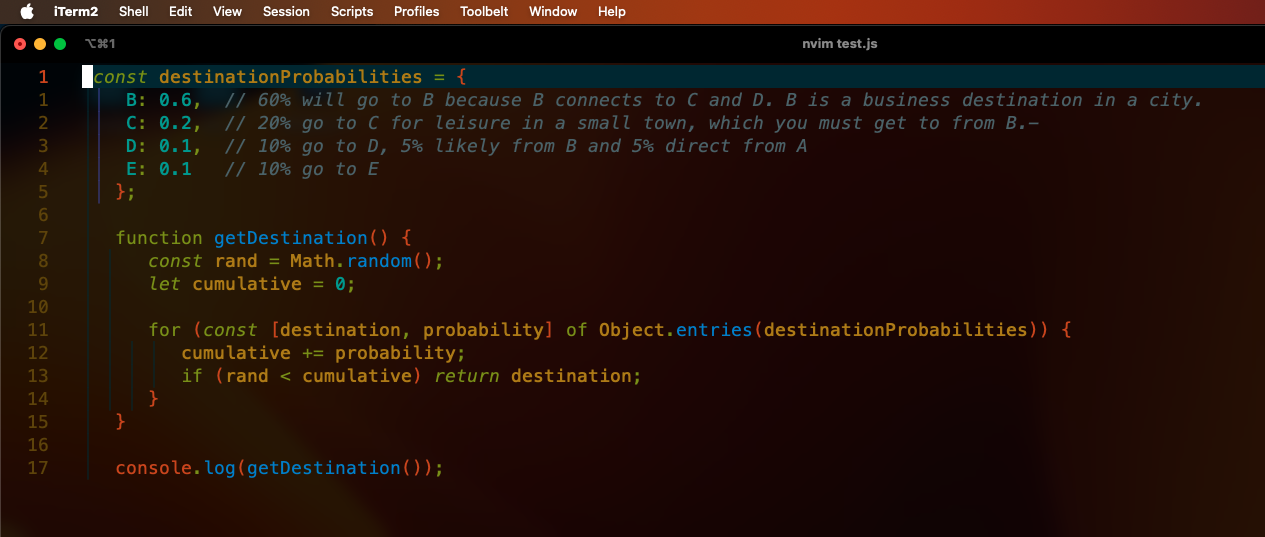
const destinationProbabilities = {
 B: 0.6,  // 60% will go to B because B connects to C and D. B is a business destination in a city.
 C: 0.2,  // 20% go to C for leisure in a small town, which you must get to from B.
 D: 0.1,  // 10% go to D, 5% likely from B and 5% direct from A
 E: 0.1   // 10% go to E
};

function getDestination() {
   const rand = Math.random();
   let cumulative = 0;

   for (const [destination, probability] of Object.entries(destinationProbabilities)) {
      cumulative += probability;
      if (rand < cumulative) return destination;
   }
}

console.log(getDestination());
Runtime#

Works cited#
Schneider, G. Michael, and Judith Gersting. Invitation to Computer Science. 6th ed., Cengage Learning, 2013.