Unit five, section three#
Artificial intelligence
Challenge work submission#
Read chapter 15 of the textbook.
Complete challenge work: write a brief review and description of a favourite book or movie depicting AI and/or robotics.
Black mirror, season 2 episode 4#
Warning
Spoilers ahead.
For my submission on AI in television, I chose Black Mirror Season 2, Episode 4 for its jarring concept.
Black Mirror explores near-future “what if?” dystopian scenarios, often centered on AI and technology. In this episode, two characters wake up in a winter cabin. Realizing they’ve been there for years, they recount their past stories. One worked for a company that created AI clones of users (contained in a home hub) to manage home automation.
It’s later revealed the cabin itself is an AI instance, and the characters are digital copies. Their stories expose details to crimes being used in a real-time court case where their real life counterparts are accused. The most striking part is the ending. One character is acquitted of their crimes, but “blocked” by society and the victim, which makes them appear blurred and muted to others.
This concept resonated with me given my past work in anti-CCTV and recognition technology. I had never considered the inverse application: technology deliberately erasing someone from reality. The brief ending shows the impossibility of communicating, and how society avoids someone who is blurred.
The jarring ending is only made worse when the viewer realizes that this barrier exists in todays current world, but in different ways (accessibility, wealth disparity, homelessness, vision or physical impairment, etc.)
Works cited#
Schneider, G. Michael, and Judith Gersting. Invitation to Computer Science. 6th ed., Cengage Learning, 2013.
Assignment 5 (chapter fifteen, section five)#
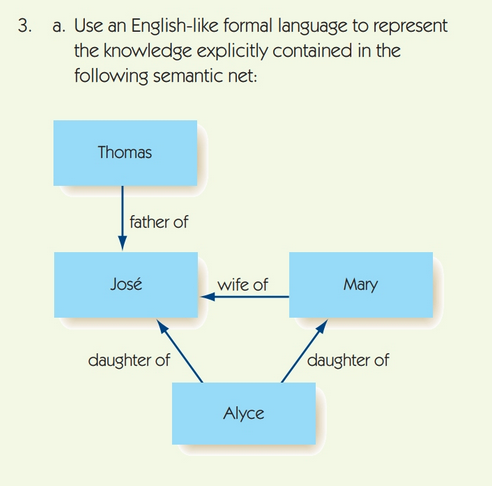
3a - 3b. Use an English-like formal language to represent the knowledge explicitly contained in the following semantic net. Add to your list from Exercise 3a the knowledge that can be inferred from the semantic net. (Chapter 15, page 724, 725)
Solution#
Answer
Thomas is the parent of Jose.
Jose is the child of Thomas.
Mary is the wife of Jose.
Alyce is the parent of both Jose and Mary.
Add to your list from Exercise 3a the knowledge that can be inferred from the semantic net.
Thomas is a grandfather of Alyce.
Jose is the husband of Mary.
Mary is a daughter in law to Thomas.
Mary and Jose are married.
Alyce is a grandchild to Thomas.
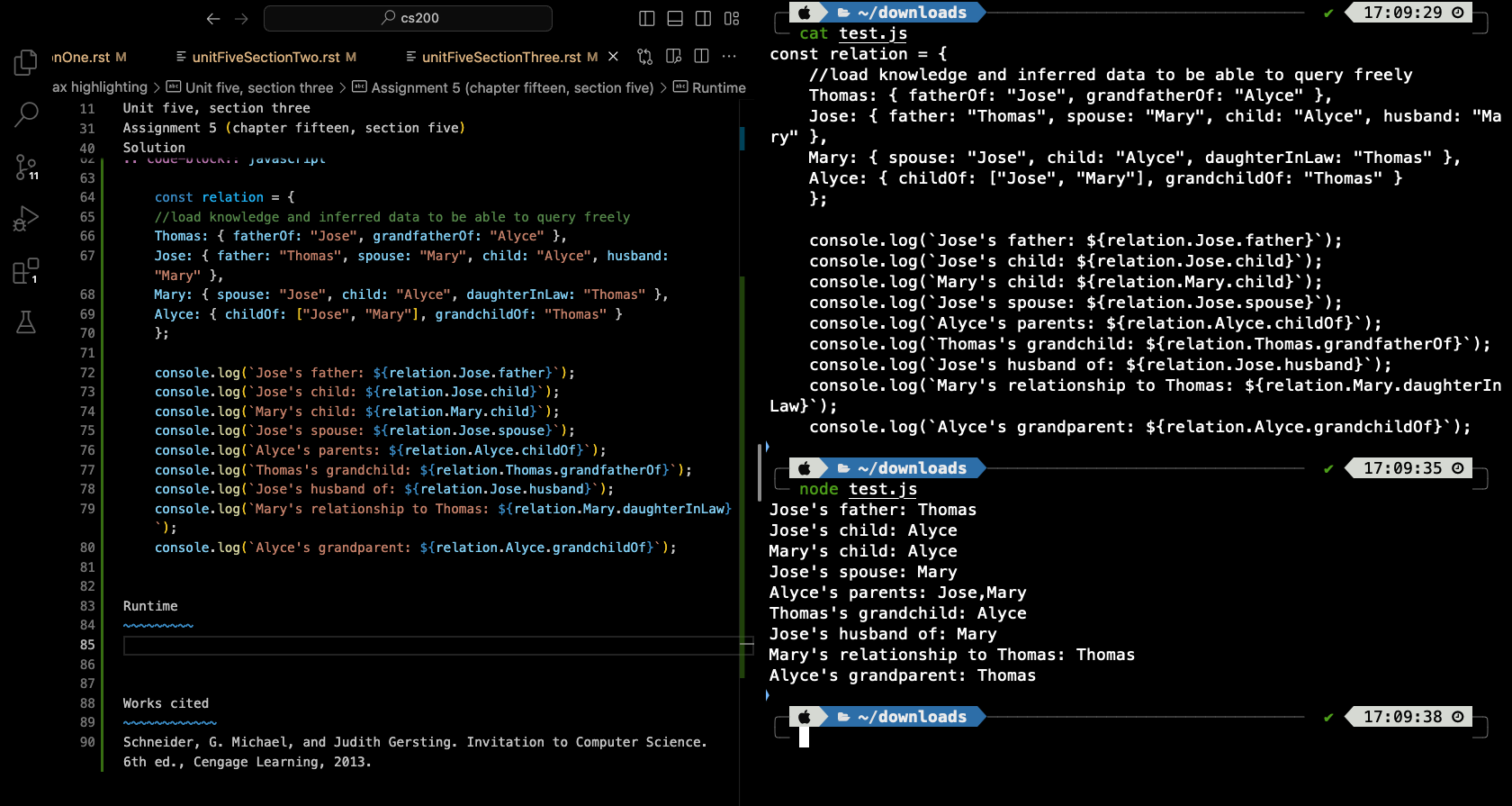
I can use object structs to store relationships, then query them as needed. As an example:
const relation = {
//load knowledge and inferred data to be able to query freely
Thomas: { fatherOf: "Jose", grandfatherOf: "Alyce" },
Jose: { father: "Thomas", spouse: "Mary", child: "Alyce", husband: "Mary" },
Mary: { spouse: "Jose", child: "Alyce", daughterInLaw: "Thomas" },
Alyce: { childOf: ["Jose", "Mary"], grandchildOf: "Thomas" }
};

console.log(`Jose's father: ${relation.Jose.father}`);
console.log(`Jose's child: ${relation.Jose.child}`);
console.log(`Mary's child: ${relation.Mary.child}`);
console.log(`Jose's spouse: ${relation.Jose.spouse}`);
console.log(`Alyce's parents: ${relation.Alyce.childOf}`);
console.log(`Thomas's grandchild: ${relation.Thomas.grandfatherOf}`);
console.log(`Jose's husband of: ${relation.Jose.husband}`);
console.log(`Mary's relationship to Thomas: ${relation.Mary.daughterInLaw}`);
console.log(`Alyce's grandparent: ${relation.Alyce.grandchildOf}`);
Runtime#
Works cited#
Schneider, G. Michael, and Judith Gersting. Invitation to Computer Science. 6th ed., Cengage Learning, 2013.